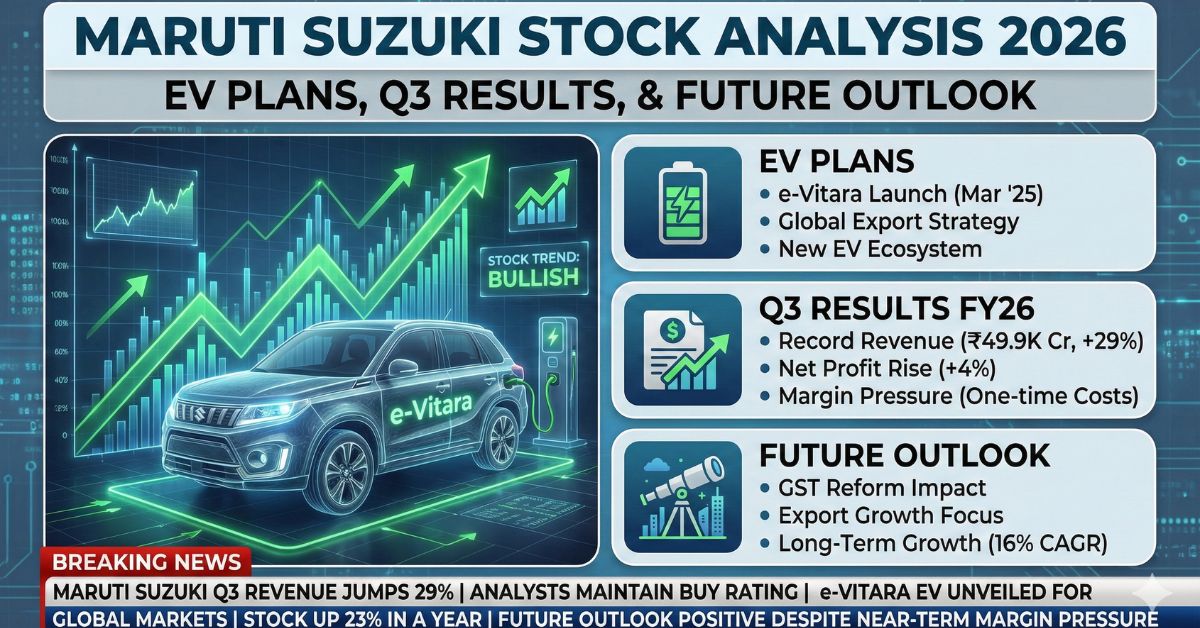
The start of 2026 has been a whirlwind for Maruti Suzuki India Limited. As the country’s largest carmaker, its performance is often seen as a heartbeat for the Indian automotive sector. Recently, the company released its financial results for the third quarter of the 2025-26 fiscal year (Q3 FY26). While the numbers showed record-breaking sales and revenue, the stock market responded with caution. Investors are currently weighing the company’s massive volume growth against tightening profit margins and a challenging competitive landscape.
Record Revenue Meets Profit Pressures
Maruti Suzuki reported a record quarterly revenue of approximately ₹49,891 crore in Q3 FY26, marking a significant 29% jump compared to the same period last year. This surge was primarily driven by a recovery in the small car segment, which benefited from a favorable GST environment. In terms of volume, the automaker achieved its highest-ever domestic sales of over 5.64 lakh units.
However, the net profit tell a more complex story. The company posted a consolidated net profit of ₹3,794 crore, a modest 4% increase from the previous year. This figure fell short of analyst expectations, which were pegged closer to ₹4,261 crore. The “miss” in profit was largely attributed to a one-time provision of nearly ₹594 crore related to the implementation of new Labour Codes in India.
Current Share Price Movement
Following the earnings announcement on January 28, 2026, Maruti Suzuki’s share price saw a sharp decline. The stock fell by more than 3% in a single session, trading around the ₹14,350 to ₹14,880 range. This movement extended a losing streak for the stock, which has seen its value erode by nearly 14% since the beginning of January 2026.
Market experts point out that the stock is currently testing its 200-day exponential moving average (DEMA) support, which is near the ₹14,700 mark. While the long-term trend remains positive—with the stock up over 20% in the last year—the short-term sentiment has turned “bearish” as investors worry about rising costs and the impact of lower-margin models on the bottom line.
Why the Market is Concerned
Despite the record sales, several factors are making investors nervous. First, the company is ramping up its investment in Electric Vehicles (EVs). While necessary for future growth, these investments often weigh down current margins. Second, a new trade agreement between India and the European Union has led to tariff cuts on imported European cars, introducing tougher competition in the premium segment.
Furthermore, analysts from firms like Ambit Capital have raised concerns that Maruti’s volume-led strategy might be prioritizing market share over profitability. On the flip side, brokerages like Emkay Global remain “Bullish” in the long term, citing an aggressive product pipeline and a potential rebound in the entry-level car market.
Looking Ahead: EV Launches and Amalgamation
The year 2026 is set to be a transition year for Maruti Suzuki. The company is preparing to launch its first major electric vehicle, the e Vitara, expected in early 2026 with a price tag around ₹20 lakh. Other anticipated launches include electric versions of the WagonR and a three-row Grand Vitara.
Operationally, the company has completed the merger of Suzuki Motor Gujarat with Maruti Suzuki India. This move is expected to streamline manufacturing and improve supply chain efficiency. While the stock might face volatility in the coming months, these strategic shifts aim to secure the company’s dominance in a rapidly evolving green-energy market.
Frequently Asked Questions (FAQs)
What is the current share price of Maruti Suzuki in January 2026?
As of late January 2026, Maruti Suzuki’s share price is trading between ₹14,350 and ₹14,900. The price has seen a downward trend recently following the Q3 earnings report.
Why did Maruti Suzuki’s profit miss analyst estimates?
While revenue was at an all-time high, the profit was impacted by higher operating costs and a one-time expense of about ₹594 crore due to the new Labour Codes.
Is Maruti Suzuki a good stock to buy for the long term?
Many analysts maintain a “Buy” or “Hold” rating because of the company’s debt-free status and strong market share. However, short-term pressures from EV spending and global competition are currently affecting the price.
What are the upcoming car launches for Maruti in 2026?
The most awaited launch is the e Vitara, Maruti’s first fully electric SUV. Other expected models include the WagonR Electric and a refreshed Baleno.
What was the impact of the Suzuki Motor Gujarat merger?
The merger, effective from April 2025, helps Maruti Suzuki bring all manufacturing under one roof, which is intended to reduce costs and improve production speed over time.