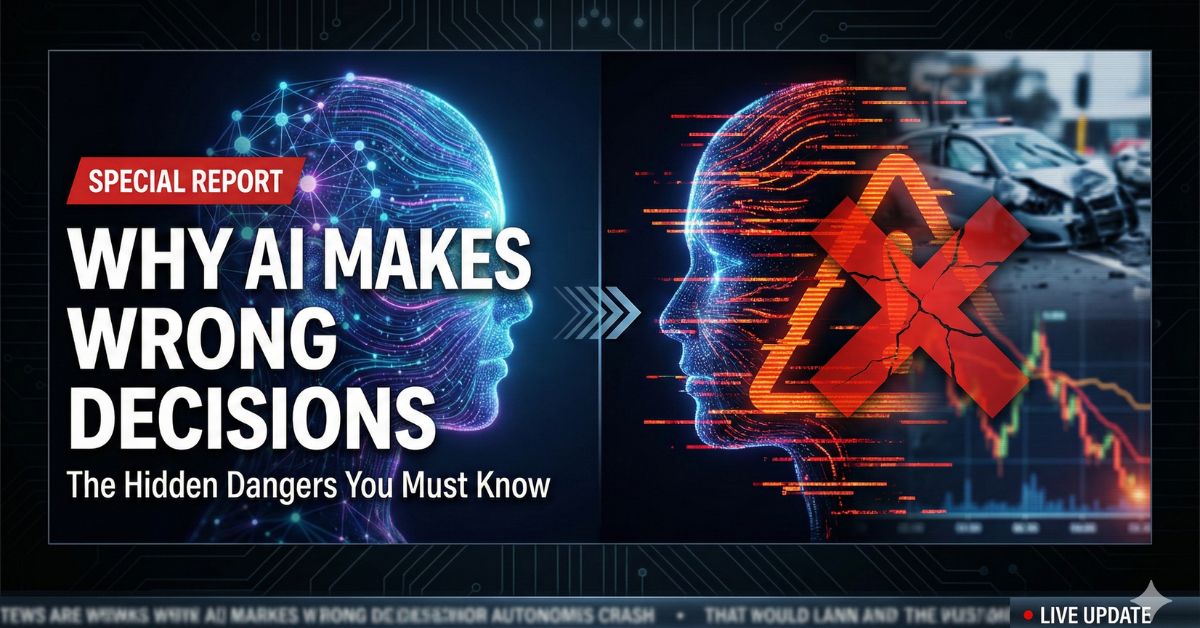
We are starting to trust Artificial Intelligence (AI) with everything. From writing emails to approving bank loans and even driving cars, AI is everywhere. But here is a scary fact: AI often makes mistakes that humans cannot easily see.
Sometimes, an AI chatbot confidently invents a fake fact. Other times, a hiring algorithm rejects a qualified candidate for no clear reason. This is not just a “glitch.” It is happening because of how AI “thinks” behind the scenes.
For users in India, where AI is growing fast in banking, healthcare, and jobs, understanding these hidden errors is critical. Here is a simple breakdown of why AI gets it wrong and what you should watch out for.
The “Black Box” Problem: It’s Guessing, Not Thinking
Many people believe AI is like a super-smart digital brain that knows the truth. In reality, most modern AI (like ChatGPT or Gemini) is just a prediction machine.
Think of it like the “autocomplete” on your phone, but much more powerful. When you ask a question, the AI does not “know” the answer. It calculates the probability of which word comes next based on billions of patterns it learned from the internet.
This creates a “Black Box” problem.
- Input: You ask a question.
- The Box: The AI does complex math that even its creators don’t fully understand.
- Output: It gives an answer.
Because it is guessing based on patterns, it can sound very confident even when it is completely wrong. This is called a “Hallucination.” The AI isn’t lying on purpose; it just values the pattern of the sentence more than the fact itself.
Why AI Often Fails in India
AI models are trained on data. If the data is mostly from the US or Europe, the AI will not understand the Indian context. This leads to specific types of wrong decisions in our country.
1. The Language Barrier
Most AI is trained heavily on English. It struggles with Indian languages, dialects, and mixed “Hinglish.”
- Example: An AI translation tool might misinterpret a local Hindi idiom or slang, completely changing the meaning of a legal document or news report.
2. Cultural Bias and Data Voids
India is diverse. We have many religions, castes, and skin tones. However, if an AI is trained mostly on photos of fair-skinned people from the West, it may fail to recognize Indian faces correctly.
- Impact: This can cause errors in Facial Recognition systems used for security or attendance. The AI might confuse two different people or fail to identify someone entirely because its “training data” didn’t have enough Indian examples.
Types of “Silent” Errors
AI makes wrong decisions in three main ways that happen behind the scenes:
1. Hallucinations (Fake Facts)
The AI invents information to fill a gap. For example, if you ask for a quote from a famous Indian leader about a specific topic, the AI might make up a quote that sounds real but was never actually said.
2. Algorithmic Bias
This is when the AI is unfair.
- In Hiring: An AI resume scanner might learn that successful employees in the past were mostly men from big cities. It might then secretly downgrade resumes from women or candidates from Tier-2 cities in India, thinking they are “less likely to succeed.”
- In Loans: Banks use AI to check credit scores. If the AI data shows that people from a certain pin code often default on loans, it might reject a strictly honest person just because they live in that area.
3. Drift
AI models get “stale.” An AI trained on data from 2021 might give you financial advice that was good back then but is dangerous in 2025. It doesn’t know the world has changed unless it is updated.
The Real-World Impact on You
These are not just technical problems; they affect real lives in India.
- Job Seekers: You might be rejected for a job not because you lack skills, but because an AI bot didn’t like the format of your CV.
- News Readers: We are seeing a rise in “AI slop”—low-quality news articles generated by bots. These can contain fake quotes or wrong numbers about government schemes, misleading the public.
- Scams: Scammers are using AI to clone voices. A mother might get a call from her “son” asking for money, but it is actually an AI replicating his voice.
What Is Being Done?
The good news is that experts and the government are waking up to this.
- Human-in-the-Loop: Companies are realizing they cannot leave AI alone. Critical decisions (like firing an employee or diagnosing a disease) now require a human to double-check the AI’s work.
- IndiaAI Mission: The Government of India has launched the IndiaAI Mission. One of its goals is to build datasets that are Indian. They want to train AI on Indian languages and faces so the technology works better for us.
- Better Testing: Developers are now using “Red Teaming.” This means they hire experts to attack their own AI to find flaws and hallucinations before the public uses it.
Conclusion: Trust but Verify
AI is a powerful tool that can help India grow, but it is still learning. It makes mistakes because it relies on math, not morals.
Read More : Why Your Mobile is Slow
For now, the best approach is “Trust but Verify.” If AI gives you medical advice, check with a doctor. If it gives you investment tips, talk to an expert. Never assume the machine is always right.
Frequently Asked Questions (FAQs)
Q: Why does AI make up fake facts?
A: AI works like a predictive text tool. It guesses the next word to make a sentence sound good. Sometimes, it prioritizes sounding smooth over being factually correct.
Q: Can AI be biased against Indians?
A: Yes. If the AI is trained mostly on Western data, it may not understand Indian names, faces, or cultural contexts, leading to unfair decisions in hiring or security.
Q: What is the “Black Box” in AI?
A: The “Black Box” refers to the complex internal math of an AI. Even the engineers who built it often cannot explain exactly why the AI gave a specific answer.
Q: Is the Indian government regulating AI?
A: Yes, the government is working on the Digital India Act and the IndiaAI Mission to ensure AI is safe, trusted, and works well for Indian citizens.
Q: How can I spot AI errors?
A: Always double-check facts, especially numbers, dates, and quotes. If a photo looks “too perfect” or a text sounds robotic, be skeptical.