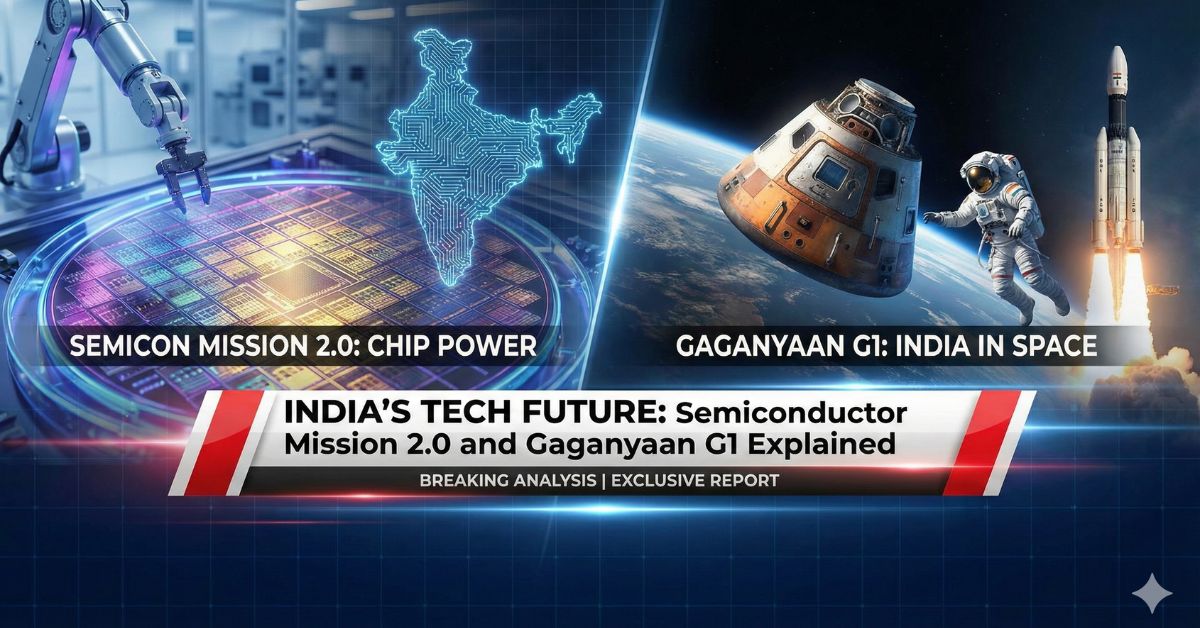
India’s technology landscape just received its biggest upgrade yet. Following the Union Budget 2026-27 presented on February 1, the government has made it clear that the next phase of “Digital India” is not just about using software, but about building the hardware and intelligence behind it.
From a massive push for homegrown semiconductor tools to the confirmed launch date of India’s first step toward human spaceflight, this week has been packed with action. If you are following India’s rise as a global tech power, here is a complete breakdown of what is happening right now and why it changes the game for the economy and jobs.
India Semiconductor Mission 2.0: Moving Beyond Making Chips
The biggest headline from the recent budget is the launch of the India Semiconductor Mission (ISM) 2.0. While the first mission focused on setting up factories (fabs) to manufacture chips, ISM 2.0 goes a step deeper.
Finance Minister Nirmala Sitharaman announced that the government will now focus on the entire “stack.” This means India won’t just assemble chips; it will now design the intellectual property (IP) and manufacture the specialized equipment and materials needed to make them. A fresh allocation of ₹1,000 crore has been set aside for FY 2026-27 to kickstart this phase.
This is a critical shift. By making the machines and chemicals required for chip manufacturing, India reduces its dependency on foreign imports even further. Industry experts are calling this a move toward “true autonomy” in electronics.
The ₹1,000 Crore AI Push & Data Center Incentives
Artificial Intelligence (AI) was another centerpiece of the announcements. The government has allocated ₹1,000 crore specifically for the IndiaAI Mission. The goal is simple: ensure that the benefits of AI reach everyone, from farmers to students, not just big tech companies.
To support this, India needs massive computing power. The budget introduced a major incentive to attract global players: a tax holiday until 2047 for foreign companies that set up cloud and data center services in India. This is expected to trigger a boom in data center construction across cities like Mumbai, Chennai, and Noida, effectively turning India into a “data factory” for the world.
Countdown Begins: ISRO’s ‘Vyommitra’ Flies in March
While policymakers focused on chips and code, the Indian Space Research Organisation (ISRO) dropped a massive update for space enthusiasts. The agency has confirmed that the first uncrewed mission of the Gaganyaan program (codenamed G1) is scheduled for March 2026.
This flight will not carry humans yet. Instead, it will carry Vyommitra, a humanoid robot designed to simulate human functions. Vyommitra will test the life-support systems of the crew module to ensure it is safe for Indian astronauts (Gaganyatris) to fly in 2027.
This mission is a “make-or-break” test for India’s human spaceflight ambitions. A successful launch next month will place India in the final lap of becoming only the fourth nation in the world to send humans to space independently.
What About 6G?
The buzz isn’t ending with 5G. The government and telecom bodies are already preparing for the next leap. The “India’s 6G Vision & Future Networks Summit 2026” is set to take place later in March. With 5G rollout nearly complete, the focus is shifting to indigenous 6G research, aiming to have India-designed 6G technology ready by 2030.
Why This Matters for You
These developments are not just technical jargon; they translate into real-world impact:
- New Jobs: ISM 2.0 and the Data Center boom will create thousands of high-skilled jobs in hardware engineering, chemical processing, and cloud management.
- Cheaper Electronics: As India starts making its own chip components, the cost of laptops, phones, and smart devices could eventually stabilize or drop.
- Global Standing: Successful execution of the Gaganyaan G1 mission and high-end chip design will cement India’s reputation as a serious technology superpower, attracting more foreign investment.
What Happens Next?
All eyes are now on March 2026. It will be a historic month with ISRO’s launch and the 6G summit. Meanwhile, tech companies will begin applying for the new incentives under ISM 2.0 immediately. The government has signaled that the “Techade” is shifting gears from planning to aggressive execution.
Read More : Is Your Job Safe?
Frequently Asked Questions (FAQs)
Q1: What is India Semiconductor Mission 2.0?
It is the second phase of India’s chip program. Unlike the first phase which focused on factories, this phase focuses on designing chips, making the machines that build chips, and producing the raw materials.
Q2: When is the Gaganyaan mission launching?
The first uncrewed flight (G1), carrying the robot Vyommitra, is scheduled for March 2026. The manned mission with astronauts is planned for 2027.
Q3: How does the new budget help AI in India?
The budget allocated ₹1,000 crore to the IndiaAI Mission and offered tax breaks to foreign companies to build data centers in India, which will increase computing power for AI projects.
Q4: Will 6G come to India soon?
Commercial 6G is not expected until around 2030. However, research and development are starting now, with major summits and testing happening in 2026.