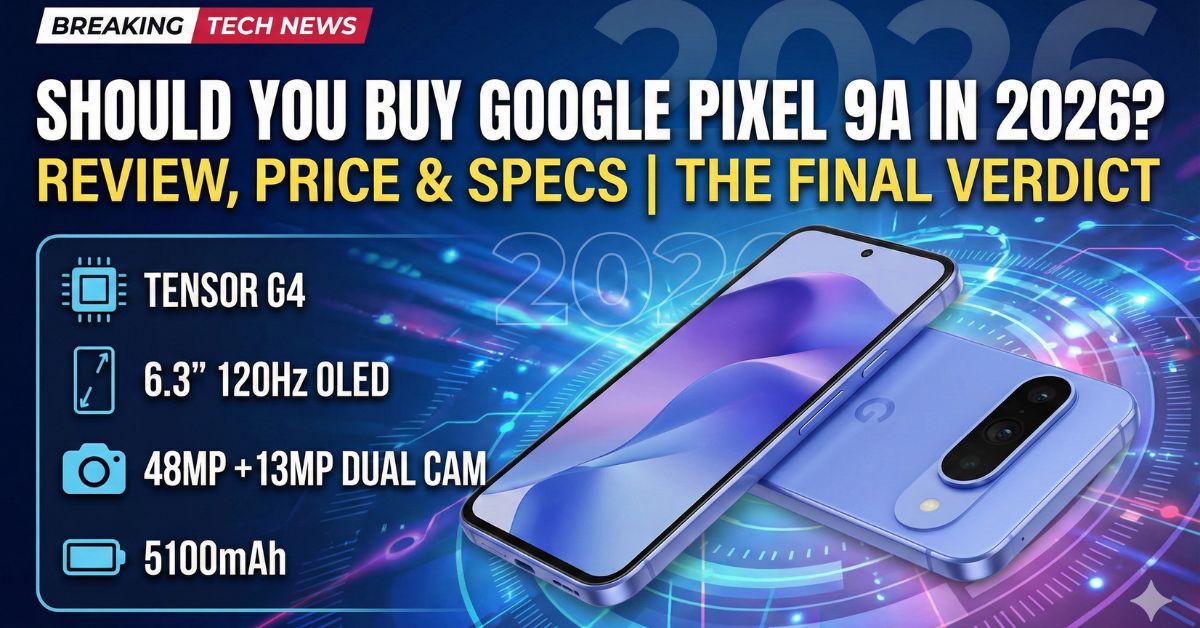
In the fast-evolving world of technology, timing is everything. As we navigate through early 2026, the smartphone market in India is flooded with options ranging from the powerful OnePlus 15R to the reliable Samsung Galaxy S-series. However, one device that continues to spark debate—and offers—is the Google Pixel 9A.
With the rumors of the Pixel 10A looming on the horizon (scheduled for a mid-February 2026 announcement), the price of the Pixel 9A has seen a significant drop, making it a tempting proposition for budget-conscious buyers. But is it still a worthy “daily driver” for you? Whether you are a tech enthusiast, a busy professional, or someone upgrading from an older device, this detailed review will help you decide if the Pixel 9A deserves a spot in your pocket.
The “Budget King” Dilemma of 2026
The Google Pixel 9A, launched back in March 2025, represented a shift in Google’s design philosophy. It ditched the iconic camera “visor” bar for a flush, flat back, polarizing fans but offering a practical benefit: it sits flat on a table. Fast forward to 2026, and this device is now positioned as a value champion.
For many users, a smartphone is like a reliable car—it needs to get you from point A to point B safely, efficiently, and without breaking down. The Pixel 9A promises exactly that: a clean software experience, class-leading cameras, and a battery that simply refuses to die. But with 8GB of RAM and 23W charging, does it feel outdated compared to the 100W charging speeds of Chinese competitors?
In this comprehensive guide, we will look “under the hood” of the Pixel 9A, analyzing its performance, camera, and long-term viability.
Google Pixel 9A: Specifications Snapshot
Before we dive into the real-world experience, let’s look at the raw numbers that power this machine.
| Feature | Specification |
| Display | 6.3-inch Actua OLED, 120Hz Refresh Rate (60-120Hz) |
| Processor | Google Tensor G4 (4nm) |
| RAM/Storage | 8GB LPDDR5X |
| Rear Camera | 48MP Main (OIS) + 13MP Ultra-wide |
| Front Camera | 13MP Ultrawide Selfie |
| Battery | 5100 mAh (Typical) |
| Charging | 23W Wired |
| Protection | IP68 Water/Dust Resistance, Gorilla Glass 3 |
| Software | Android 15 (Upgradable), 7 Years of Updates |
Design and Build: A Practical Approach
When you hold the Pixel 9A, the first thing you notice is the departure from the “robotic” visor look of the Pixel 8 series. The back is completely flat. For users who carry their phones in tight jeans or mount them on car dashboards for navigation, this flush design is a blessing—it doesn’t wobble.
The build quality feels premium despite the use of a composite (plastic) back. It mimics the matte finish of higher-end cars, resisting fingerprints and smudges effectively. The frame is recycled aluminum, providing a sturdy chassis that can withstand daily wear and tear.
However, the bezels around the 6.3-inch display are noticeably thicker than those on the Samsung Galaxy S24 FE or the OnePlus 15R. While it gives the phone a slightly “retro” look, it also prevents accidental touches when you are holding the phone purely for navigation or media consumption.
Display Experience: Bright Enough for the Road?
The Pixel 9A features a 6.3-inch Actua OLED display. In our testing, the panel hit a peak brightness of 2700 nits. This is a crucial metric for anyone who spends time outdoors. If you are a bike rider using your phone for maps under direct Indian sunlight, this screen remains perfectly legible.
The 120Hz refresh rate makes scrolling through news feeds or app drawers feel incredibly smooth. Google has tuned the colors to be natural rather than oversaturated. It supports HDR10+, making it a fantastic device for watching YouTube videos during your commute.
Performance “Under the Hood”: Tensor G4 Analysis
The engine driving the Pixel 9A is the Google Tensor G4. Unlike the Snapdragon chips found in gaming phones, the Tensor G4 is not built for raw horsepower or drag racing; it is built for efficiency and smarts.
Daily Driver Capability
For 90% of users, the Tensor G4 is more than adequate. Apps open instantly, switching between Google Maps and Spotify is seamless, and the UI never stutters. The phone handles “traffic” (multiple apps open) well, thanks to Google’s aggressive memory management, although the 8GB RAM cap is a slight bottleneck for heavy multitaskers.
Gaming & Thermal Management
If you are a hardcore gamer expecting 90fps in BGMI or Call of Duty, you might want to look elsewhere. The Pixel 9A can run these games, but it tends to throttle (slow down) after 30 minutes of intense play to keep the “engine” cool. It doesn’t overheat to dangerous levels, but it gets warm—similar to a car engine after a long drive.
Camera Review: The Best in Its Class
This is where the Pixel 9A leaves competitors in the dust. Google’s computational photography is the equivalent of having an expert co-pilot who fixes your mistakes automatically.
Daylight Photography
The 48MP main sensor captures images with stunning dynamic range. The “Pixel look”—contrasty, detailed, and cool-toned—is present here. Whether you are photographing your new car, a landscape, or documents, the clarity is unmatched in the sub-40k price segment.
Night Sight & Low Light
The Night Sight mode is legendary. In pitch-black conditions, the Pixel 9A pulls in light like magic. For safety reasons, if you are ever stranded on a dark road and need to take a photo of a landmark or a vehicle number plate, this phone will not let you down.
Video Capabilities
Video quality has improved significantly over the Pixel 7a/8a. The stabilization (OIS + EIS) acts like high-quality suspension, smoothing out bumps and shakes when you are walking or recording from a moving vehicle.
Battery Life: The Long-Haul Performer
The biggest surprise of the Pixel 9A is its 5100 mAh battery. Because the Tensor G4 is efficient and the screen is smaller than the Pro models, this phone is a marathon runner.
- Real-world usage: In our testing, the phone easily lasted 1.5 days with moderate use (Social media, 2 hours of navigation, calls).
- Standby time: The deep sleep optimization is excellent. You can leave it unplugged overnight and only lose 2-3%.
The Downside: Charging speed. At 23W, it takes over 1.5 hours to fill the “tank” from 0% to 100%. This is slow compared to the “pit stop” speeds of 15 minutes seen in other brands. You will need to develop a habit of charging it overnight.
Software and AI: Your Digital Assistant
The Pixel 9A runs on Android 15 out of the box (upgradable to future versions). The interface is clean—no bloatware, no spammy ads, just pure Google.
- Circle to Search: A handy feature where you can circle anything on the screen to search for it. Saw a cool alloy wheel on Instagram? Circle it and find the price instantly.
- Call Screen: In India, spam calls are a menace. The Pixel’s Call Screen acts as a gatekeeper, answering spam calls for you and showing you a transcript. It’s a massive quality-of-life upgrade.
Maintenance and Care Tips
Just like your vehicle requires regular service, your Pixel 9A needs care to last its promised 7-year lifespan.
- Battery Health: Do not let the battery drain to 0% often. Try to keep it between 20% and 80% (“The Golden Zone”) to extend the battery’s chemical life. Use Adaptive Charging, which learns your wake-up time and finishes charging right before you wake up.
- Port Hygiene: The USB-C port can collect pocket lint. If charging becomes finicky, use a wooden toothpick (gently) or compressed air to clean it out.
- Storage Management: Since there is no SD card slot, manage your 128GB/256GB wisely. Use Google Photos’ “Free Up Space” tool to delete photos that are already backed up to the cloud.
- Heat Protection: Do not leave your phone on the car dashboard in direct sunlight. High heat degrades the battery and the OLED display permanently.
Safety and Security Features
In an automobile context, safety is airbags and ABS. In a smartphone context, safety is data privacy and personal security. The Pixel 9A excels here.
- Car Crash Detection: This is a literal lifesaver. The Pixel 9A uses its accelerometer and microphone to detect if you’ve been in a severe car accident. It can automatically dial emergency services (112 in India) and share your location if you are unresponsive.
- Titan M2 Chip: A dedicated security chip that protects your passwords, banking apps, and biometric data from hackers. It’s like an immobilizer for your digital life.
- VPN by Google One: Built-in VPN protection keeps your browsing safe when you are connected to public Wi-Fi at airports or cafes.
Pros and Cons Summary
Pros:
- Incredible Battery Life: The 5100 mAh cell is a beast.
- Camera Quality: Still the best “point and shoot” camera under ₹40,000.
- Software Support: 7 years of OS updates means this phone will be relevant until 2032.
- Car Crash Detection: A vital safety feature for commuters.
- Price: With the pre-10a discounts, it offers immense value.
Cons:
- Slow Charging: 23W is painfully slow in 2026.
- Thick Bezels: Looks dated compared to curved screens.
- Gaming Performance: Not built for heavy gaming sessions.
- Fingerprint Sensor: The optical sensor is good, but ultrasonic ones are faster.
Should You Buy It? (The Verdict)
The question is: Should you buy the Pixel 9A in February 2026?
YES, if:
- You want a phone that simply works without fuss.
- You prioritize battery life and camera quality over gaming.
- You want a device that will receive updates for years to come.
- You can find it for under ₹40,000 (approx. $480).
NO, if:
- You are a heavy gamer.
- You need ultra-fast charging (look at OnePlus or Xiaomi).
- You want the absolute latest design (Wait for the Pixel 10A, launching later this month).
Final Verdict:
The Google Pixel 9A is the “Toyota Camry” of smartphones—it isn’t the flashiest or the fastest, but it is incredibly reliable, safe, and efficient. With the recent price cuts anticipating the Pixel 10A launch, the 9A provides arguably the best value-for-money proposition in the Indian market right now. It is a smart, safe investment for the long road ahead.
Read More : Realme P4 Power 5G
FAQ: Common Questions
Q1: Is the Google Pixel 9A waterproof?
A: Yes, it has an IP68 rating, meaning it can withstand submersion in fresh water up to 1.5 meters for 30 minutes. It is safe to use in the rain or if you accidentally drop it in a puddle.
Q2: Does Pixel 9A support 5G in India?
A: Absolutely. It supports all major Indian 5G bands (Jio and Airtel). The reception is stable, and it switches seamlessly between 5G and 4G to save battery.
Q3: Can I use the Pixel 9A for navigation on my bike?
A: Yes. The screen is bright enough (2700 nits) for outdoor use. However, prolonged exposure to direct sunlight and heat while navigating can cause the phone to dim the screen to protect itself.
Q4: Does it come with a charger in the box?
A: No. Like most modern vehicles not coming with a spare tyre sometimes, the Pixel 9A box contains only the phone and a USB-C cable. You will need to buy a compatible 30W PD charger separately.
Q5: Is the Pixel 9A better than the OnePlus 15R?
A: It depends. The OnePlus 15R is faster and charges much quicker (better for gamers). The Pixel 9A has a better camera, better software, and longer battery life (better for casual users).
Q6: What is the “Car Crash Detection” feature?
A: This is a safety feature where the phone senses a high-impact collision. It vibrates and sounds an alarm; if you don’t dismiss it, it calls emergency services automatically. It is highly recommended to enable this feature.