If you are an electric vehicle (EV) enthusiast in India, you have likely noticed the massive success of the Hyundai IONIQ 5. It changed the game with its retro-futuristic design and practical range. But now, all eyes are on its sleeker, sportier sibling: the Hyundai IONIQ 6.
With the Indian EV market heating up and competitors like the BYD Seal and BMW i4 grabbing headlines, one question is on every car lover’s mind: Is the Hyundai IONIQ 6 actually coming to India?
In this detailed guide, we will break down the latest news, expected launch timelines, pricing strategies, and real-world practicality of this “Electrified Streamliner” for Indian roads.
The Verdict: Is the IONIQ 6 Launching in India?
The short answer is yes, it is highly likely.
While Hyundai India has been tight-lipped about a specific date, the signs are undeniable. The car was showcased at the Auto Expo 2023, generating massive interest. Furthermore, with the BYD Seal seeing unexpected success in the premium electric sedan segment (priced between ₹41–53 Lakhs), Hyundai needs a direct answer to protect its dominance in the premium EV space.
Expected Launch Timeline
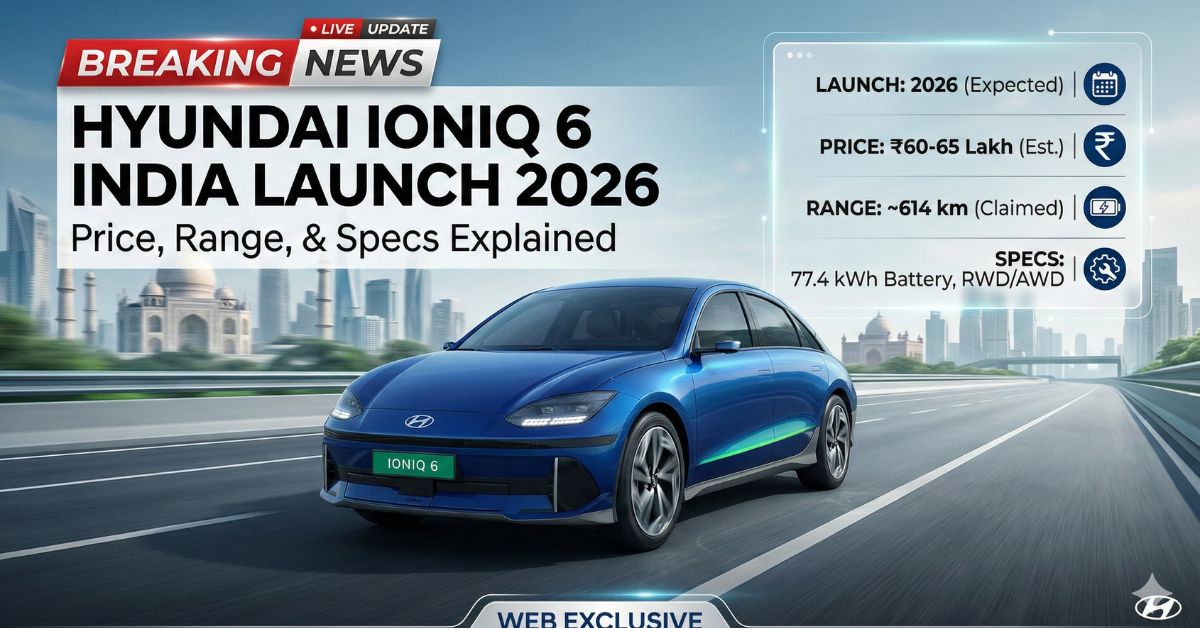
Industry insiders and recent automotive trends suggest a launch window of late 2025 or early 2026.
- Why the delay? Hyundai is currently focusing on the high-volume mass market with the upcoming Creta EV (likely to launch first). Once the mass-market EV is established, the IONIQ 6 will likely arrive as a “Halo Product” (flagship) to showcase the brand’s technological prowess, likely via the CKD (Completely Knocked Down) route to keep taxes lower, similar to the IONIQ 5 strategy.
Design: The “Electrified Streamliner”
The first thing you will notice about the IONIQ 6 is that it looks nothing like the boxy IONIQ 5. Hyundai calls this design the “Electrified Streamliner.”
Why Does It Look So Curvy?
It isn’t just for style; it’s for aerodynamics. The IONIQ 6 has an ultra-low drag coefficient of 0.21 Cd.
- For Beginners: The lower the drag coefficient, the easier the car cuts through the air. Less air resistance means the battery doesn’t have to work as hard, resulting in more range.
- Real-Life Example: Think of it like a bullet train vs. a truck. The IONIQ 6 is shaped like a smooth pebble to glide on highways, making it one of the most efficient EVs in the world.
It features over 700 Parametric Pixels (those tiny square LED lights) in the headlamps, tail lamps, and even the interior, keeping the signature family look alive.
Interior: A “Mindful Cocoon”
Hyundai has designed the cabin to feel like a living space rather than just a car cockpit.
Key Features for Indian Buyers:
- Dual 12.3-inch Screens: One for the instrument cluster and one for infotainment, joined seamlessly.
- Flat Floor: Thanks to the E-GMP platform (Electric-Global Modular Platform), there is no transmission tunnel. This means massive legroom for rear passengers—perfect for Indian families where being chauffeur-driven is common.
- Sustainable Materials: The seats are made from recycled PET bottles, and the carpets are made from recycled fishing nets.
- V2L (Vehicle-to-Load): This is a verified favorite in the IONIQ 5. You can use the car’s charging port to power a laptop, a coffee machine, or even camping gear. In India, this is a lifesaver during power cuts or long road trips.
Battery, Range, and Performance
This is where the IONIQ 6 shines. It is expected to come to India with the Long Range battery pack.
- Battery Capacity: 77.4 kWh
- Claimed Range (WLTP): Up to 614 km
- Real-World Range in India: Expect 450–500 km in mixed city and highway driving with AC on. This is more than enough for a Delhi to Jaipur or Mumbai to Pune round trip on a single charge.
Charging Speed
The car supports 800V ultra-fast charging.
- 10% to 80% in 18 minutes: If you find a 350 kW DC fast charger (still rare in India, but growing).
- Standard 50 kW DC Charger: It will take roughly 70 minutes for the same charge, which is standard for a coffee break on the highway.
Power Specs (Expected for India)
- RWD (Rear Wheel Drive): ~225 BHP / 350 Nm Torque (Likely the primary model for India to keep costs low).
- AWD (All Wheel Drive): ~320 BHP / 605 Nm Torque (0-100 km/h in 5.1 seconds).
Expected Price in India
Pricing is the make-or-break factor. If Hyundai brings the IONIQ 6 as a CBU (Completely Built Unit), taxes will push the price over ₹65 Lakhs. However, if they assemble it locally (CKD) at their Chennai plant—which they did for the IONIQ 5—they can price it aggressively.
- Estimated Price: ₹55 Lakh – ₹65 Lakh (Ex-Showroom)
This places it slightly above the IONIQ 5 (₹46 Lakh) but directly in the crosshairs of the BYD Seal and Kia EV6.
The Competition: Who Stands in the Way?
The IONIQ 6 won’t have an easy fight. The Indian premium EV sedan market currently has two heavy hitters:
- BYD Seal: The current segment leader. It offers incredible performance (0-100 in 3.8s) for a lower price (starting ~₹41 Lakh). The IONIQ 6 will struggle to match this price but will win on brand trust and service network.
- BMW i4: A badge value favorite. It costs significantly more (~₹72 Lakh) but attracts buyers who want the “Luxury Badge” status.
Pros and Cons for Indian Buyers
Pros
- Incredible Range: One of the most efficient EVs globally.
- Futuristic Design: Guaranteed head-turner on Indian roads.
- Proven Platform: The E-GMP platform is reliable and safe (Global NCAP 5-star rated).
- Hyundai Service Network: Unlike Chinese competitors, Hyundai has a massive service footprint across India.
Cons
- Ground Clearance: As a low-slung sedan, it may struggle with massive Indian speed breakers compared to the IONIQ 5 SUV.
- Rear Headroom: The sloping “coupe” roofline cuts into headroom for tall passengers (6ft+) in the back seat.
- Price Premium: Likely to be ₹10-15 Lakh more expensive than the BYD Seal.
Maintenance and Safety Tips
Maintenance for EV Sedans
- Tire Care: EVs are heavy and have instant torque. Rotate tires every 5,000 km to prevent uneven wear.
- Coolant Checks: Even though it has no engine, the battery management system (BMS) uses coolant. Ensure it is topped up during service.
- Underbody Protection: Since the battery sits on the floor, be extremely careful over jagged rocks or deep potholes on Indian roads.
Safety Features
The IONIQ 6 is expected to come with Level 2 ADAS (Advanced Driver Assistance Systems) tuned for India:
- Forward Collision-Avoidance Assist.
- Lane Keep Assist (useful on Expressways like Samruddhi Mahamarg).
- 7 Airbags standard.
Conclusion: Should You Wait for the IONIQ 6?
If you are looking for a luxury electric sedan that stands out from the crowd and offers peace of mind with a reliable service network, the Hyundai IONIQ 6 is absolutely worth the wait.
However, if you need a car right now and want the best bang for your buck, the BYD Seal offers similar thrills for less money. Alternatively, if you tackle bad roads often, stick to the Hyundai IONIQ 5—it offers 90% of the tech with better ground clearance.
Final Verdict:
The IONIQ 6 is not just a car; it’s a statement. When it arrives in 2026, it will likely set the benchmark for efficiency in the Indian market.
Frequently Asked Questions (FAQs)
Q1: What is the expected launch date of Hyundai IONIQ 6 in India?
A: While not officially confirmed, industry trends point to a launch in March 2026 or mid-2026.
Q2: Will the IONIQ 6 be cheaper than the IONIQ 5?
A: No. The IONIQ 6 is positioned as a more premium, tech-loaded sedan. Expect it to cost roughly ₹10 Lakh more than the IONIQ 5.
Q3: What is the ground clearance of the IONIQ 6?
A: The global spec is roughly 141mm, which is low. Hyundai India might raise the suspension slightly for Indian roads, but it will still be a low sedan.
Q4: Can I charge the IONIQ 6 at home?
A: Yes. Hyundai usually provides a 11kW AC Wallbox charger with the car, which can fully charge the battery overnight (approx. 7-8 hours).
Q5: Is the IONIQ 6 safe?
A: Yes, it has received a 5-Star Safety Rating from Euro NCAP and comes with advanced ADAS safety features.