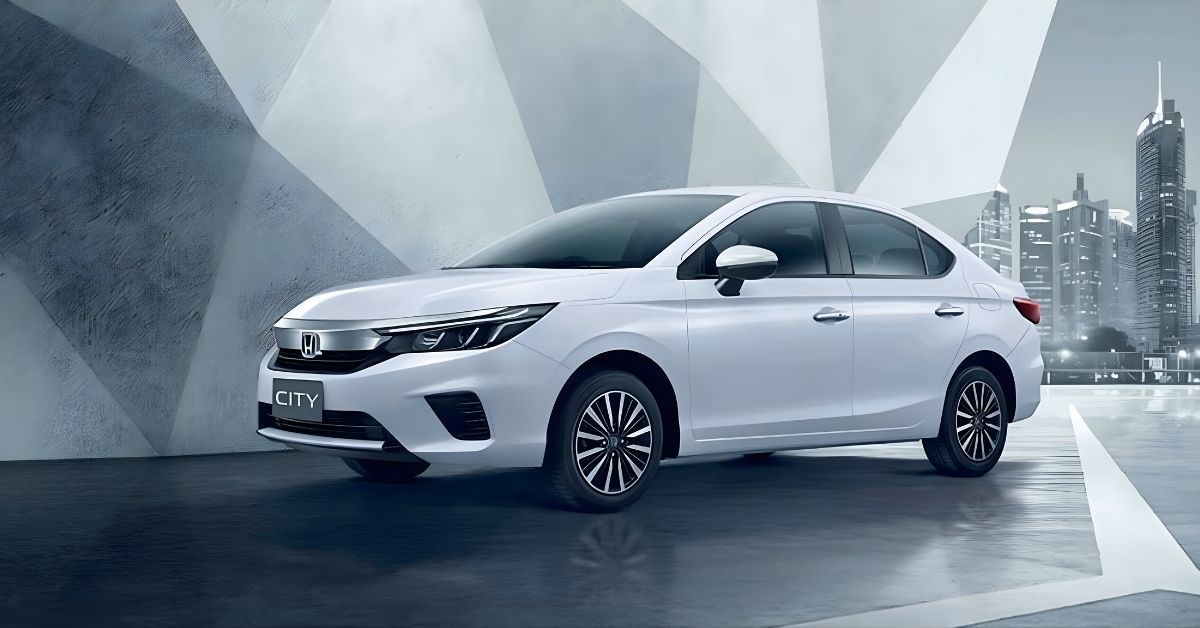
In a market obsessed with “High-Riding” SUVs, the Honda City stands tall (well, not literally) as the last bastion of the traditional 3-box sedan. For over 25 years, this car has been the default choice for middle-class Indian families. It’s the car you buy when you want to tell the neighbors, “I have arrived.”
But let’s be real. It’s 2026. The roads are filled with Hyundai Cretas and Kia Seltos. Is the low-slung Honda City still relevant?
With an ex-showroom price starting around ₹11.82 Lakh and going up to ₹16.35 Lakh (and touching ₹20 Lakh+ for the Hybrid), the City isn’t exactly cheap anymore. But it promises something SUVs can’t give you—unbeatable rear-seat comfort and that legendary i-VTEC refinement. I drove the top-spec ZX CVT for a week to see if the “King” still deserves the crown.

2. Quick Specs Table: The Numbers
Read more: Renault Duster 2026
| Feature | 1.5L i-VTEC Petrol | 1.5L e:HEV Hybrid |
| Power | 121 PS @ 6600 rpm | 126 PS (Combined) |
| Torque | 145 Nm @ 4300 rpm | 253 Nm (Motor Torque) |
| Transmission | 6-Speed MT / 7-Step CVT | e-CVT |
| 0-100 km/h | ~10.5 Seconds | ~9.5 Seconds |
| Boot Space | 506 Litres | 306 Litres (Battery eats space) |
| Ground Clearance | 165 mm | 165 mm |
| Fuel Tank | 40 Litres | 40 Litres |
3. Exterior Design & Road Presence
The 5th Generation City (facelift) has matured. It doesn’t look like a “boy racer” car anymore; it looks like a mini-Accord.
- The Front: The thick chrome bar on the nose is signature Honda. It’s polarizing—some love the “bling,” some hate it. The 9-array Inline LED Headlamps are sharp and offer excellent throw at night.
- The Stance: It is long. At 4583 mm, it looks significantly longer than a Slavia or Verna from the side profile. The character line running from the headlight to the taillight gives it a sharp look.
- The Wheels: Finally, Honda gave it 16-inch Diamond Cut Alloys that look proportionate. Remember the tiny tyres on the older City? Thankfully, those days are gone.
Road Presence: It doesn’t bully other cars off the road like a Scorpio-N, but it has an elegant, executive vibe. It commands respect in corporate parking lots.

4. Interior, Comfort & Features
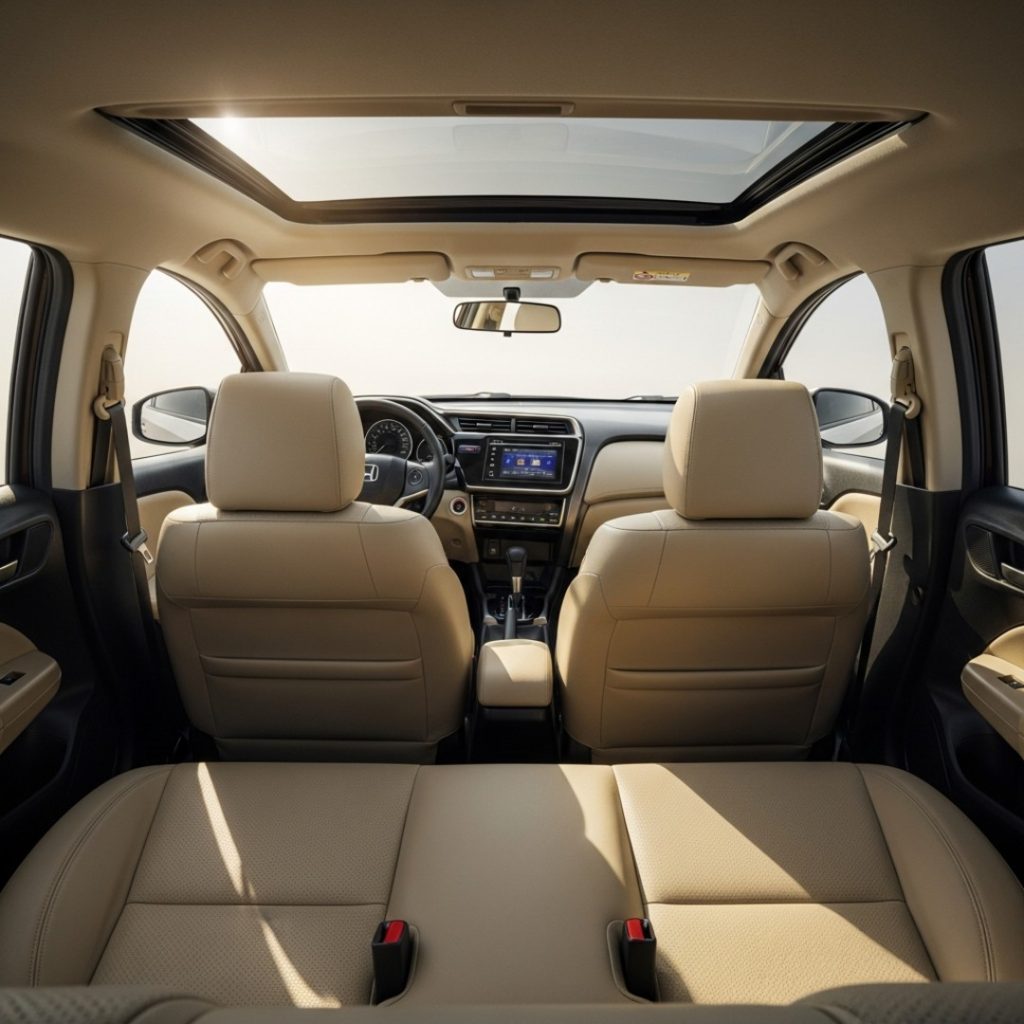
This is the Honda City’s home turf. Open the door, and you are welcomed by what is arguably the most comfortable cabin in the segment.
- The Sofa Seats: The front seats are wide and incredibly supportive. But the magic is in the back. The Rear Legroom is massive. You can cross your legs and sit like a boss. The seat cushioning is soft—perfect for Indian body types.
- Dashboard & Quality: The dual-tone beige and black theme makes the cabin feel airy. Soft-touch leather pads on the dashboard and door armrests feel premium.
- The Weak Link (Infotainment): While the 8-inch screen supports Wireless Android Auto & Apple CarPlay, the display quality feels dated. The resolution looks like it’s from 2018 compared to the 10-inch HD screens in the Verna or Slavia. Also, the reverse camera quality is quite grainy.
- Key Features: One-Touch Electric Sunroof, Ambient Lighting, Rear Sunshade (Manual), and Walk-Away Auto Lock.
5. Engine Performance & Driving Dynamics
I tested the volume seller: the 1.5L i-VTEC Petrol with CVT.
- The Engine: This naturally aspirated engine is legendary for a reason. It is butter smooth. At idle, you can’t even tell the car is on.
- City Drive: The CVT gearbox is a blessing in bumper-to-bumper traffic. It is seamless. There is no “head nod” or jerkiness like you get in DCTs or AMTs. It creeps forward smoothly.
- Highway Drive: This is where the “Rubber Band Effect” creeps in. If you stomp on the accelerator for a quick overtake, the engine noise rises disproportionately to the speed. However, for cruising at 100-120 kmph, it is effortless.
- Suspension & Handling: Honda has tuned the suspension for comfort. It absorbs city potholes beautifully. But, at high speeds on undulated highways, the rear tends to get a bit “bouncy.” It’s not as planted as a VW Virtus.
6. Safety: ADAS for Everyone
Honda made a bold move by offering Honda Sensing (ADAS) even in the manual variants, not just the top automatic.
- Standard Safety: 6 Airbags, ABS with EBD, TPMS (Tyre Pressure Monitoring), and ESP are standard across all variants.
- ADAS Tech: It uses a camera-based system.
- Collision Mitigation Braking: Works well, gives ample warning before applying brakes.
- Lane Keep Assist: It gently steers you back into the lane. It’s useful on Expressways but I recommend turning it OFF in chaotic city traffic as it fights the steering too much.
- Build Quality: It feels lighter than its German rivals (Virtus/Slavia), but the panel gaps are consistent. It has a 5-Star ASEAN NCAP rating.
7. Real World Mileage: The Truth
Honda users swear by mileage, but does the CVT deliver?
| Driving Condition | ARAI Claimed | Real World Mileage (Tested) |
| 1.5L Petrol MT (City) | 17.8 kmpl | 11.5 – 12.5 kmpl |
| 1.5L Petrol CVT (City) | 18.4 kmpl | 10.0 – 11.0 kmpl |
| Highway Cruising (Petrol) | – | 16.5 – 18.0 kmpl |
| Hybrid e:HEV (City) | 27.13 kmpl | 22.0 – 24.0 kmpl |
Note: If you drive the CVT with a heavy foot in traffic, mileage can drop to single digits (8-9 kmpl). The Hybrid is the undisputed king here if you have the budget.
8. The Competition: Honda City vs Verna vs Virtus
The sedan wars are heating up. Here is how the City stacks up against the best.
| Feature | Honda City | Hyundai Verna | VW Virtus / Skoda Slavia |
| Engine USP | Smooth, Refined i-VTEC | Powerful Turbo Petrol | Driving Dynamics & Build |
| Rear Comfort | Best in Class | Good | Average (Stiff seats) |
| Tech & Screen | Outdated | Best (Dual Screens) | Good |
| Suspension | Soft (Comfort focused) | Soft (Comfort focused) | Stiff (Handling focused) |
| Verdict | The Family Choice | The Tech/Feature Choice | The Enthusiast’s Choice |
- Winner: The Hyundai Verna beats the City on features and pure speed (Turbo variant). The VW Virtus wins on build quality and fun. But the Honda City still wins on pure rear-seat comfort and reliability.
9. Final Verdict: Is the Legend Still Alive?
The Honda City is no longer the fastest or the most tech-loaded car in its segment. It feels a bit old-school—and that is exactly why people still buy it. It is uncomplicated, extremely comfortable, and reliable.
Buy the Honda City if:
- You are Chauffeur Driven: The rear seat comfort is unmatched by any SUV under ₹20 Lakh.
- You want Peace of Mind: The i-VTEC engine will probably outlast you. Service costs are reasonable.
- You drive mostly in the City: The light steering and smooth CVT make traffic stress-free.
Skip the Honda City if:
- You want an Adrenaline Rush: The engine is linear, not punchy. The Virtus GT or Verna Turbo are much faster.
- You drive on Bad Roads: The ground clearance (165mm) is low. With a full load, the underbelly will scrape on large speed breakers.
- You want a Modern Cabin: The infotainment screen feels like it belongs in 2020, not 2026.
10. FAQs (People Also Ask)
Q: What is the on-road price of Honda City ZX CVT?
The top-spec Honda City ZX CVT costs approximately ₹18.50 Lakh to ₹19.00 Lakh (On-Road, Delhi).
Q: Does the Honda City scrape speed breakers?
With 1 or 2 people, it’s fine. But with 5 passengers and luggage, the soft suspension sags, and it tends to scrape tall speed breakers. You have to drive carefully.
Q: Is there a CNG option in Honda City?
No, Honda does not offer a factory-fitted CNG kit. If you want CNG in a sedan, look at the Maruti Ciaz or Tata Tigor.
Q: Is the Honda City Hybrid worth the extra ₹4-5 Lakhs?
Only if your daily running is very high (over 60-70 km per day). The Hybrid offers fantastic mileage (20+ kmpl) and performance, but the upfront cost takes years to recover through fuel savings alone.
Q: Does it have Ventilated Seats?
Unfortunately, No. While rivals like Verna and Slavia offer ventilated seats, the Honda City still misses out on this crucial feature for Indian summers (unless you buy an aftermarket accessory).