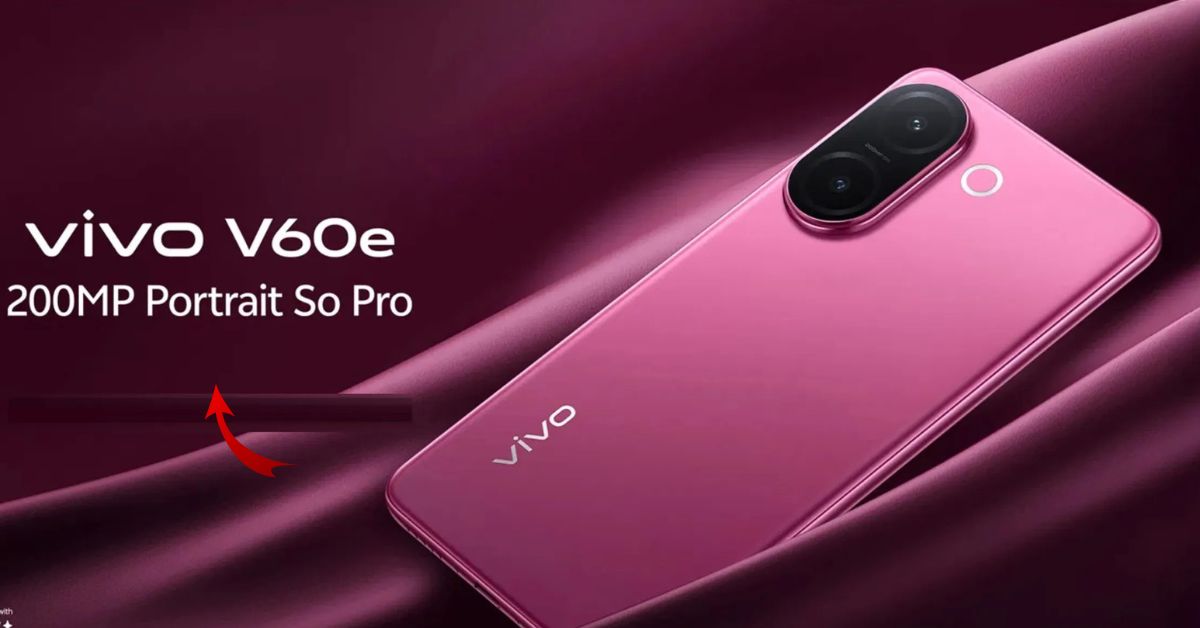
Vivo’s V-series has always been the champion of style and camera features in the mid-premium segment. Enter theVivo V60e, a phone that doesn’t just promise big—it promises huge. We’re talking about India’s first phone with a 200MP main camera at this price point, coupled with a massive 6500mAh battery and a blazingly fast 90W charger. The starting price of ₹29,999 for the 8GB/128GB variant positions it right in the deadliest battlefield of the Indian smartphone market.
The hype is real: a quad-curved AMOLED screen, flagship-level IP68/IP69 rating, and the promise of five years of security updates. On paper, it looks like a winner. But as a Senior Tech Journalist, I know that specs don’t always translate to real-world performance. The real truth is, the V60e is a phone with two flagship features and one significant Achilles’ heel.
Before you pull the trigger and spend nearly ₹30,000, let’s dive deep into the performance, endurance, and whether that 200MP camera is truly a game-changer or just a massive number on a spec sheet.
The moment you hold the Vivo V60e, you realise where a significant chunk of the budget has gone: design and premium feel.
At just 7.49 mm thick and weighing a mere 190 grams, this is one of the slimmest and lightest phones in the sub-₹30K category, especially considering the 6500mAh battery it packs. The back is a plastic composite sheet with a shimmering “Elite Purple” or “Noble Gold” finish that manages to mimic glass texture surprisingly well. It’s slippery, yes, but the case is essential anyway.
The Quad-Curved Illusion
The key design highlight is the Quad Curved AMOLED Display. The screen curves not just on the left and right sides, but also subtly along the top and bottom edges. This makes the phone feel incredibly seamless and premium in your hand—like a device from the Vivo X series, which usually costs double. The plastic frame is polished to look like metal, maintaining the illusion of a true flagship.
Durability That Stands Out
Most phones in this range offer IP54 at best. The Vivo V60e blows that out of the water with an IP68 and IP69 rating.
IP68: Submersible in 1.5 meters of water for 30 minutes.
IP69: Resistance to high-pressure, high-temperature water jets.
In simple terms, you can comfortably drop this phone in a bucket, take it to the pool, or spill a whole chai cup on it without breaking a sweat. For a phone focusing on lifestyle and style, this level of durability is a major, unexpected win and a huge selling point.
.
Vivo V60e in Noble Gold
Display & Visuals: Bright, Bold, But Just FHD+
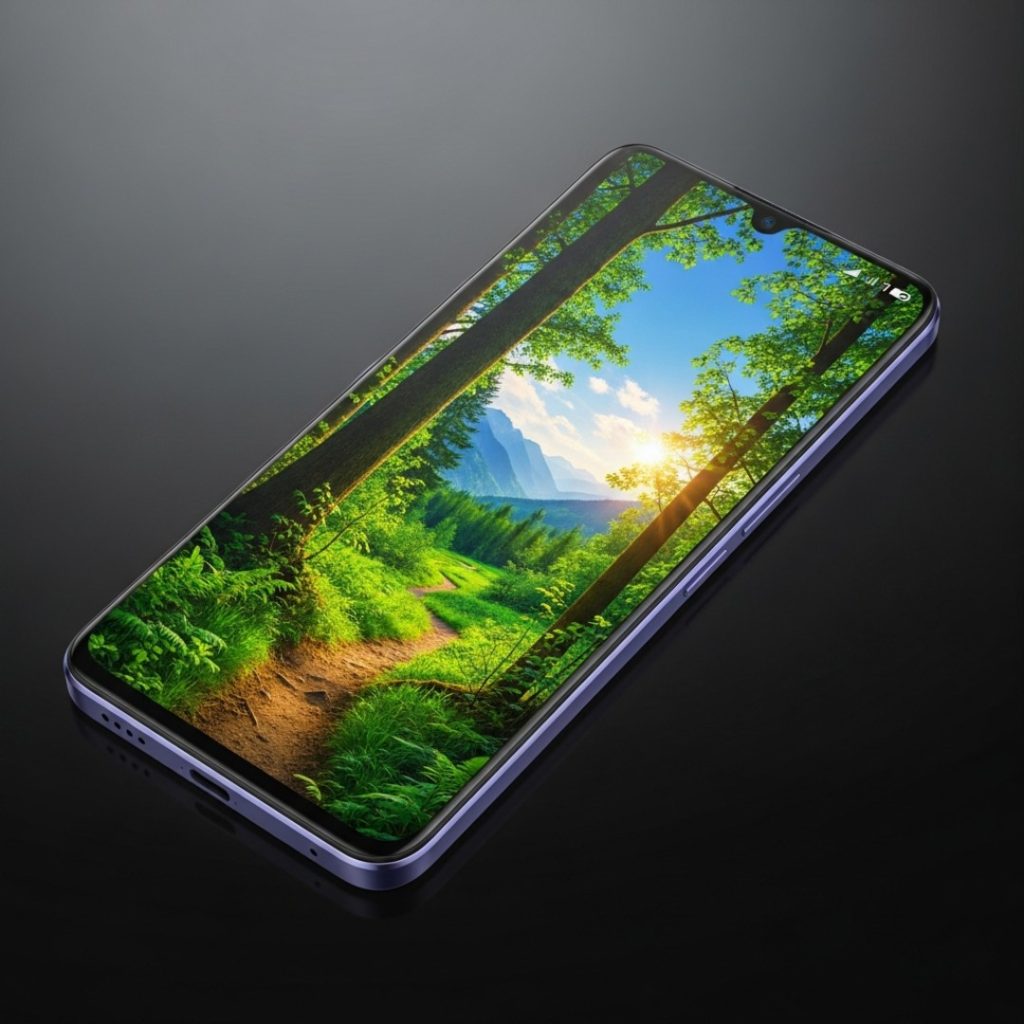
The screen quality is where Vivo traditionally excels, and the V60e largely keeps that reputation intact. You get a large 6.77-inch Quad Curved AMOLED panel with a smooth 120Hz refresh rate.
The Brightness Test
Vivo claims a local peak brightness of 1600 nits, and in our outdoor testing, the phone performed admirably. Under the harsh Indian midday sun, I had zero issues reading emails or watching YouTube. The high brightness kicks in automatically when you need it most. Watching HDR10+ content on Netflix is a vibrant experience; the colors pop, the blacks are inky deep (thanks to AMOLED), and the viewing angles are perfect.
The Resolution Caveat
However, here’s where you need to look closer. The resolution is standard FHD+ (2392 x 1080 pixels), which translates to about 388 PPI. For a phone nearing ₹30,000, some competitors are starting to offer slightly sharper 1.5K or even 1220p displays (like the Motorola Edge 60 Pro), which provides a subtle but noticeable increase in sharpness, especially for small text and complex graphics.
Don’t waste your money if your primary use case is reading extensive ebooks or you are obsessed with razor-sharp pixel density. For everything else—social media, videos, and casual browsing—this display is excellent and one of the best feeling screens on the market thanks to that aggressive curvature.
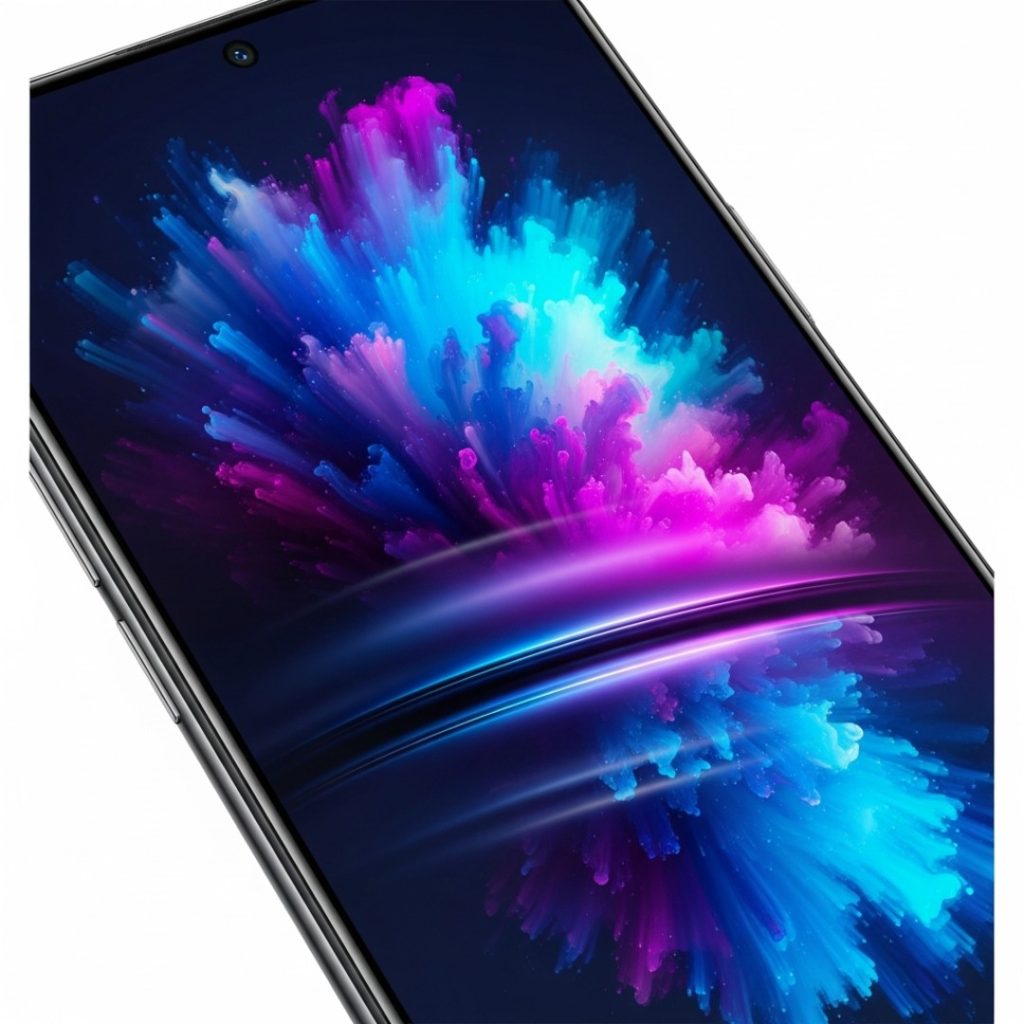
Vivo V60e screen showing a vibrant, colorful abstract wallpaper with deep blues and purples
Performance & Gaming/Usage: The Compromise
Now we address the elephant in the room: the processor. The Vivo V60e is powered by the MediaTek Dimensity 7360-Turbo (4nm) chipset, paired with fast LPDDR4X RAM and UFS 2.2 storage.
On the AnTuTu v10 benchmark, the phone scores around 895,000. On Geekbench 6, the multi-core score hovers around 2,900.
The Real-World Stress Test
Multitasking: With 8GB/12GB of RAM, day-to-day app switching, browsing, and jumping between WhatsApp, Instagram, and Chrome is buttery smooth. Funtouch OS 15 on Android 15 is well-optimized.
Gaming: We ran demanding titles like Genshin Impact and Call of Duty Mobile (CoDM).
CoDM: Easily runs at High/Max settings without any major frame drops. Performance is stable and enjoyable.
Genshin Impact: This is the real test. You can play at Medium to High settings comfortably, but pushing it to the absolute highest graphical setting causes frame drops and stutters, especially in busy combat scenes.
Heating: After a 30-minute intense gaming session, the internal temperature rose by about $10^\circ \text{C}$. The phone got noticeably warm near the camera module but never alarmingly hot, thanks to Vivo’s $16,470 \text{ mm}^2$ cooling system.
The verdict on performance is clear: The Dimensity 7360-Turbo is a very capable upper mid-range chip. It’s excellent for casual users and most gamers, but it is not a performance flagship. If you are a hardcore gamer looking for the best possible sustained frame rate at the highest settings for ₹30,000, this phone will not beat its Snapdragon-powered rivals. You are paying for the camera and battery, not the raw CPU/GPU power.
Camera / Engine: The 200MP Main Event
The Vivo V60e’s biggest claim to fame is its camera system, headlined by a 200MP Ultra-Clear Main Camera with Optical Image Stabilization (OIS). This is a massive sensor for this price bracket, aiming squarely at the high-resolution photo enthusiast.
The Primary 200MP Sensor (The Good)
The default shots are 16MP (using 16-in-1 pixel binning), and these images are stunning in good daylight.
Detail and Clarity: Shots are exceptionally sharp, with fantastic texture and detail, even in shadowed areas.
Color Science: Vivo’s colour tuning is aggressive but pleasing—social media ready right out of the box. Greens are lush, blues are punchy, and the contrast is great.
200MP Mode: Switching to the full 200MP resolution is best reserved for landscapes or when you need to crop deeply later. The file size is huge (25MB+), and while the detail is astronomical, the processing takes a second or two. The real use is the 30x SuperZoom feature, which leverages that massive resolution to deliver usable, though software-enhanced, zoomed photos.
The Supporting Cast (The Bad)
8MP Ultra-Wide: This is the weakest link. 8MP is just not enough in 2025 for a ₹30K phone. The shots lack the detail of the main lens, and the colors often look washed out compared to the 200MP sensor.
50MP Eye AF Selfie Camera: This is brilliant. The dedicated Eye Auto Focus means your selfies are consistently sharp, even in group shots. 4K video recording from the front is also a big plus for vloggers.
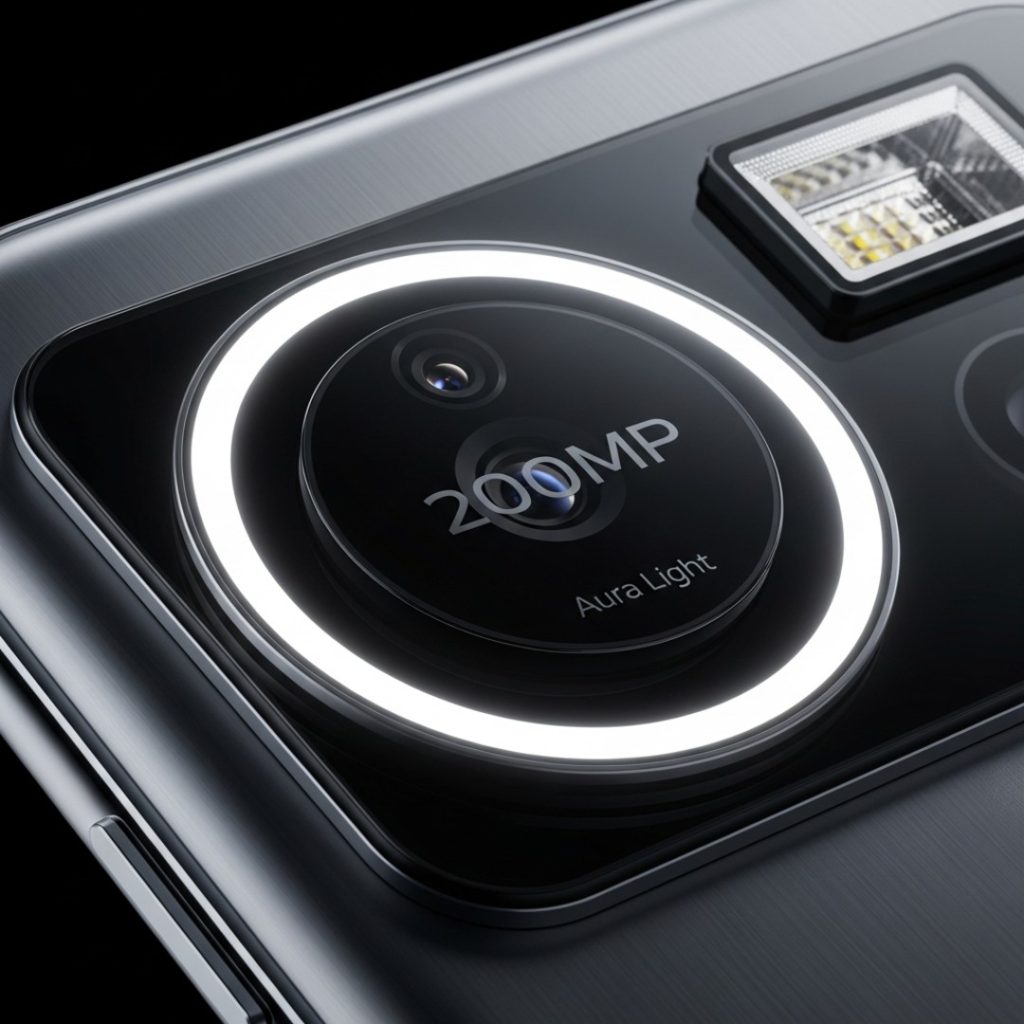
The Aura Light: Vivo’s signature feature, the Smart Aura Light, does an exceptional job of providing soft, studio-quality fill light for night portraits, making this a true ‘Portrait Master.’
Close-up macro shot of the Vivo V60e’s camera module
Battery & Endurance: The Unsung Hero
Forget the 200MP hype for a moment. The 6500mAh BlueVolt Battery is arguably the Vivo V60e’s best and most practical feature. This massive cell is what makes the slightly less-efficient Dimensity 7360-Turbo last and last.
Battery Drain Test Results
Usage Scenario
Battery Consumption (30 Minutes)
Estimated Screen-On-Time (SOT)
Video Streaming (HD)
3%
~16-17 Hours
Heavy Gaming (CoDM/Genshin)
8-9%
~5.5 Hours
Social Media/Browsing
4%
~12.5 Hours
The result is stunning: a guaranteed two-day battery life for moderate users. Even heavy users will easily get through a full day with juice to spare. In the PCMark Battery test, the V60e clocked an incredible 15 hours and 17 minutes, a score that puts it in the ‘Battery Beast’ category.
90W FlashCharge Test
Vivo includes a 90W FlashCharge adapter in the box—a welcome addition. The charging speed is fast, but not the fastest we’ve seen:
0% to 50%: 20 minutes
0% to 100%: 40 minutes
For a 6500mAh battery, a full charge in 40 minutes is phenomenal. You also get advanced features like Reverse Wired Charging and Bypass Charging (great for keeping the phone cool during gaming). This big battery/fast charging combination is the true strength of the V60e.
The Competition: Vivo V60e vs Motorola Edge 60 Pro vs OnePlus Nord 5
The ₹28,000 to ₹33,000 segment is brutal. The Vivo V60e is up against some serious heavy hitters. Based on current market trends, its two strongest rivals are the Motorola Edge 60 Pro and the OnePlus Nord 5.
Head-to-Head Comparison
Feature
Vivo V60e (₹29,999)
Motorola Edge 60 Pro (₹28,680)
OnePlus Nord 5 (₹31,117)
Processor
Dimensity 7360-Turbo
Dimensity 8350 Extreme Edition
Snapdragon 8s Gen 3
AnTuTu Score (Approx.)
895,000
~1,440,000
~1,200,000
Display
6.77″ 120Hz AMOLED (FHD+)
6.7″ 120Hz P-OLED (1220p)
6.78″ 120Hz AMOLED (1.5K)
Main Camera
200MP OIS (8MP Ultrawide)
50MP OIS + 50MP Ultrawide
50MP OIS + 8MP Ultrawide
Telephoto/Zoom
No (Digital Zoom)
10MP 3x Optical Zoom
No
Battery & Charging
6500mAh, 90W
6000mAh, 90W
6000mAh, 100W
Durability
IP68/IP69
IP68/IP69
IP65
Storage Speed
UFS 2.2
UFS 4.0
UFS 4.0
The Analysis: Who is the Real Winner?
If You Want Raw Power: The Motorola Edge 60 Pro wins hands down. Its Dimensity 8350 Extreme Edition (or Snapdragon equivalent) offers a massive performance lead—around 50-60% higher AnTuTu score—and much faster UFS 4.0 storage. This is the gaming champion.
If You Want The Best All-Rounder: The OnePlus Nord 5 strikes a fantastic balance, offering a great flagship-level processor and the clean OxygenOS experience, though its battery and durability rating (IP65) aren’t quite as impressive as the other two.
If You Want Camera, Battery, and Style: The Vivo V60e is the phone for the casual, style-conscious user. It offers the best battery life (6500mAh vs 6000mAh) and the highest resolution main camera (200MP vs 50MP). Crucially, the IP68/IP69 rating and the slim, quad-curved design make it feel far more premium than its rivals.
Clear Winner:Motorola Edge 60 Pro takes the crown for sheer performance and features (like optical zoom). However, the Vivo V60e is the winner for endurance and design. If a two-day battery and a camera that takes stunning, colourful portraits are your priority, the V60e is a strong, distinct choice. Don’t buy the V60e if performance is your number one priority.
The Vivo V60e is not trying to be a gaming phone. It is a luxury mid-ranger designed for the user who prioritizes aesthetics, camera quality, and battery life over raw processing power. It provides a flagship-level feel—that quad-curved screen and the rugged IP68/IP69 rating—at a mid-premium price.
The trade-off for the huge battery, premium design, and 200MP camera is the Dimensity 7360-Turbo, which, while capable, is simply not in the same performance league as the chips found in its equally priced competitors.
Buy it if:
You must have the best battery life: The 6500mAh cell with 90W charging is an endurance champion that easily provides two-day battery.
You want premium design and durability: The quad-curved screen and IP68/IP69 water resistance make it feel like a ₹50,000 phone.
You are a portrait/social media enthusiast: The 200MP main camera and 50MP Eye AF selfie camera, coupled with the Aura Light, deliver stunning, highly-processed, ready-to-share photos.
Skip it if:
You are a hardcore mobile gamer: The Dimensity 7360-Turbo chipset is a significant step down from the flagship-killer chips in its competitors.
You need the fastest storage: UFS 2.2 is slower than the UFS 4.0 found in performance rivals, meaning app loading and file transfer times are marginally slower.
You value a clean software experience: Funtouch OS is better than before, but it still has noticeable bloatware compared to the Motorola or OnePlus rivals.
FAQs (People Also Ask)
Q1: Does the Vivo V60e have a 3.5mm headphone jack?
A: No, the Vivo V60e does not feature a 3.5mm headphone jack. It relies on the USB Type-C port for audio, which is common for phones in this price segment.
Q2: What is the benefit of the IP69 rating on the Vivo V60e?
A: The IP69 rating means the phone can withstand high-pressure, high-temperature water jets, making it exceptionally resistant to dust and water, even more so than the standard IP68 rating. It offers superior protection against accidental spills and harsh weather conditions.
Q3: Is the Dimensity 7360-Turbo good for gaming?
A: The Dimensity 7360-Turbo is good for most gaming, handling popular titles like CoDM and Free Fire very well on high settings. However, for demanding games like Genshin Impact at max settings, it is outperformed by competitors using chips like the Snapdragon 8s Gen 3 or Dimensity 8350
Q4: How many Android updates will the Vivo V60e get?
A: Vivo has promised excellent long-term support for the V60e, including up to 3 Major Android OS Version Updates (taking it up to Android 18) and 5 Years of Security Updates. This is a great commitment to longevity.
Q5: Is the 200MP camera on the V60e better than the 50MP camera on other phones?
A: Not always. While the 200MP sensor captures immense detail in good light (especially useful for zooming/cropping), the quality of the image mostly depends on the sensor size and processing. The V60e’s 200MP main sensor is excellent, but its 8MP Ultra-Wide lens is weak. Competitors with better 50MP sensors (especially those with optical zoom or better wide-angle lenses) can produce more versatile results.